Tuesday

Five Reasons I Had to Write This Book


Deepak Malhotra thought that the business bestseller "Who Moved My Cheese?" made some good points about the need to anticipate and adapt to change, but he also took issue with the book’s core message: accept that change is inevitable and beyond your control, don’t waste your time wondering why things are the way they are, keep your head down and start chasing after more cheese. So he wrote "I Moved Your Cheese", which offers an altogether different perspective—one that challenges the notion that we are simply mice in a maze, subject to the designs of others and destined to chase blindly after cheese.

Here are the five compelling reasons he felt he had to write this book:

Reason # 1: Because some of the greatest barriers to success are internal. In the face of established practices, traditional ideas, scarce resources and the powerful demands or expectations of others, we often underestimate our ability to control our own destiny and overcome the constraints we face -- or think we face.

Reason # 2: Because we need more people who will challenge the old way of doing things. We need to think twice before telling would-be innovators, problem solvers, entrepreneurs, and leaders that instead of wasting their time wondering why things are the way they are, they should simply accept their world as given.

Reason # 3: Because what is impossible to control today, may be possible to control tomorrow. Even in situations where things are beyond our control, we should do more than blindly accept our fate. We should still seek to understand why the change was forced on us, how we might exert greater control over our lives or business in the future, and what it would take to escape the kinds of mazes in which we are always subject the designs of others.

Reason # 4: Because we're often unaware that we are in the maze. Too often we are blindly chasing after the cheese, and not stopping to think whether the goals we are chasing are the correct ones. This is as true for students who are picking a major, as it is for graduates picking a career, or mid-career folks working towards the next promotion.

Reason #5: Because intellect and intent are often not enough. For the most difficult problems we face in business and in life, being smart, hard-working and well-intentioned is not sufficient. We need to challenge longstanding assumptions, see the old in new ways, and be willing to chart our own, unique course towards success.

Sunday

Five Companies That Are Not What You Thought They Would Be


It's always easy to tell which companies are doing good work and behaving and which ones are not, right? Actually, it's not. Some companies are very good at covering up their misdeeds while others get lumped with some ugly accusations that never go away despite all that they do.

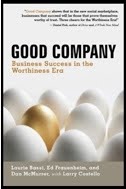
For this issue, the authors of Good Company list companies that are not what you thought they would be by assigning a “Good Company” grade of A to F to five major players in the Fortune 100. The grade is based on their status as good employers, good sellers, and good stewards of the environment and their communities.

Here are five of the more surprising companies and their grades:

1. Walmart -- the company that so many love to hate –- earns a C (rather than the F that many readers might have expected). Why? Partly because of its significant advances in going green on a humongous scale and its use of its core capabilities to tackle hunger.

2. CVS Caremark -- operator of thousands of neighborhood drugstores -- received a D. It racked up government penalties of over $38 million in recent years due to Medicaid prescription drug fraud and potential violations of federal privacy regulations. On top of that, it got lousy marks as an employer.

3. Disney –- the “happiest place on earth” —- (appropriately enough) earns the highest grade of A. It did so by getting the basics -- being a good employer, seller and steward -- and by abiding by the law and avoiding greedy behavior.

4. Hewlett-Packard -- seen for decades as a paragon of corporate virtue -- only earned a C. Dismal scores from its employees on HP as a place to work were among the negative categories that offset some of HP’s more positive attributes, including its high green/sustainability rankings.

5. Goldman Sachs -- for many the poster-boy for corporate greed -- earns a B. Although many readers may grind their teeth, saying that Goldman deserves an F, there is in fact a great deal they have done right over the years. But to thrive in the future, they are going to need to improve their performance to an A or risk a future of mediocrity or worse.

You can find details behind these grades – as well as the grades of other Fortune 100 companies – at the Good Company Index.

So what do you think? Did Bassi and co-authors get it right or wrong? Chime in below.

Monday

Eight Ways to See a Baseball Game


People tend to see things in a very "flat" way. However, there are in fact many ways to experience even the most basic activity, which means businesses can now offer customers a whole range of immersive encounters. Joe Pine and Kim Korn have explored what this multiverse offers in their new book Infinite Possibility.

For example, thanks to the multiverse and using their core theory of the eight key types of immersive models, Joe and Kim explain how there are actually eight ways to participate in a simple baseball game:

1. Reality (Space, Matter, Time): You are in the bleachers of your hometown baseball team, cheering them on.

2. Augmented Reality (No Space, No Matter, Time): While watching the game, you are checking your iPhone for stats on the players, information about the game, and checking in on FourSquare.

3. Alternate Reality (Space, No Matter, No Time): You are playing an online Rotisserie league based on real players’ performance in actual games, but translated into a web-based computer experience.

4. Warped Reality (Space, Matter, No Time):
You are attending an old-timer’s fantasy camp with retired players, and maybe even old uniforms from a time gone by. No aluminum bats here!

5. Virtuality (No Space, No Matter, No Time): Ah, here is a familiar category. Your Playstation video game is entirely virtual.

6. Augmented Virtuality:(No Space, Matter, No Time): This is a tricky one! You send your favorite Little League player a physical Hallmark greeting card that shows his favorite characters in 3D when he holds it up to his computer screen.

7. Physical Virtuality (No Space, Time, Matter): This realm brings the virtual to the physical. Design your favorite baseball stadium in LEGO’s on your computer — LEGO will send you a complete kit in the mail.

8. Mirrored Virtuality (Space, No Matter, No Time):
Major League Baseball Gameday allows you to review every throw and every hit from various camera angles in 3D. One game could be relived for hundreds of years if you wanted to see it all!

Five Reasons Why the Talent Leaves


Wendy Axelrod and Jeannie Coyle's new book explores how talent development can best be facilitated by the managers the talents work with every day. Developing talent is important, especially since simply retaining talent is enough of a challenge. Every day, organizations lose their highest-potential employees to things that could have been avoided. Here are five of the most common avoidable reasons why the talent leaves:

1. Ineffective Ways of Giving Feedback and Measuring Performance.
This is not about the contents of the feedback but the way in which the feedback is communicated. Many companies do not do a very effective job at giving feedback and even a positive interaction can leave the talent irritated. Feedback is usually non-existent or "breezed through" hurriedly giving the impression to the employee that the company doesn't really value them.

2. Wandering Priorities.
Most companies are great at setting up a strategic directive but lousy at sticking with it. The talent then ends up giving his or her all to something that has -- since being assigned -- become a lower-level priority for the organization (but no one told the talent that). That kind of frustration and feeling of disrespect will have 'em heading for the door.

3. Not Keeping Other Talents in the Organization. Top talent often measures itself against others, so when a talented individual is in a group with other talented individuals, it creates an energetic and fulfilling working environment. However, pairing top talent with moderate to weak performers not only slows down the talent but makes him or her question their value to the organization and how much growing and learning can be done within that particular workplace.

4. Corporate Bureaucracy. Often cited as one of the most common reasons people leave organizations, bureaucracy is tolerated by companies of all sizes and not just larger institutions. In order for talent to develop, it must be allowed to explore and expand in non-traditional ways ("freedom to grow"). If there's a strong bureaucratic vibe in the organization, the talent feels obstructed and blocked at every turn. He or she will immediately leave for another place where they have more room to move.

5. A Lack of Exciting Projects.
Everyone has a small measure of work that is administrative and perhaps dull, and talented individuals don't expect each day to be a exciting challenge. But often these individuals are never given anything that challenges them and gives them an opportunity to exercise and develop their talents. Sooner or later, boredom and the inability to do anything outside of the most mundane of duties will drive the talent out.

Thoughts? Responses? Ideas?

Friday

Five Lesser-Known Facts About Mother Teresa


She was an incredible leader and remains an inspiration to this day to the global order that she founded as well as common people in all walks of life. But, like all of us, she was human and had the same frailties and often had to make the same compromises that all of us do in order to get things done. Some have argued that Mother Teresa should not be granted sainthood, but many have also argued that it is what makes her human that makes her worthy of recognition. Decide what you will, here are five things about Mother Teresa you probably won't like to hear:

1. She was not always strong in her faith. Documents and private letters that have been found (many published in the edited collection of her writings called Come Be My Light) attest to several periods in her life when Mother Teresa questioned her faith and the power of God, stating at one point, "Deep down, there is nothing in me by emptiness and darkness."

2. She had a reputation for treating others in her order callously. Many former nuns that worked with Mother Teresa and her order have come forward to claim that there were many practices instituted by her holiness that were almost draconian. One of these nuns, Susan Shields, who worked with Mother Teresa for nine years, has written for decades trying to dispel "The Myth of the Mother." She wrote in an article that "In San Francisco, the sisters were given the use of a three-story convent, but they pushed the mattresses out the windows and removed all the sofas, chairs and curtains... the house was made to conform to a way of life intended to help the sisters become "holy." The heating remained off all winter in this exceedingly damp house. Several Sisters got TB during the time I lived there.”

3. She accepted money from crooks and thieves. Christopher Hitchens has written in his bestseller, The Missionary Position, that Mother Teresa accepted $500,000 from famed bilker Charles Keating. When it was revealed to her by Charles Turley, then the Deputy District Attorney for Los Angeles, that Keating had stolen the money and was asked to return any portion of it that she could, she refused to comply or even respond. She also accepted $10,000 from John Roger, a fanatical and corrupt cult leader who claimed to be superior to Christ.

4. She underwent an exorcism because demonic possession was suspected.
In her later years, she became even more temperamental, reportedly flying into a rage for minor issues and behaving erratically. In fact, her mood became so erratic that she even underwent an exorcism at one point.

5. The millions of dollars Mother Teresa's charities took in remain unaccounted for. Several investigators including author and documentarian Aroup Chatterjee have discussed the economics behind how the charities operated and how the medical care that was dispensed to the needy was severely lacking and not representative of the millions of dollars that were being contributed by people worldwide. In the BBC 4 documentary, Hell's Angel, it is pointed out repeatedly that all sisters in the order lived in poverty in the same hovels as those they served and that medical care was severely lacking. But when questioned as to where the funds that were being funneled into the organization were going, no answer was forthcoming.

Misconceptions? Easily misinterpreted errors of assumption? Rumors? Or just evidence that like us all, Mother Teresa was a human being?

Tuesday

These Aren't Your Old-School Customers


Chip Bell and John Patterson's new book Wired and Dangerous explores how the customer relations field has changed rapidly with the advent of new technology and new options and how businesses need to update their ways of dealing with those customers or risk shutting down.

In this post, Chip and John list five ways in which customers today are different from customers yesterday -- and what this means for you:

1. Yesterday: Unhappy customers would write a letter to the CEO or ask to speak to the manager.

Today: They post a rant or complain on Yelp or their blog or Twitter or start a Facebook page against the business.

Why You Should Worry: The presence of social media and the internet means that this is no longer an issue between a customer and a company, it’s a public brawl and everyone is invited. Worse yet, people have the tendency to believe the customer, so you’re suddenly feeling threatened by a whole bunch of people you don’t even know.


2. Yesterday: Customers would raise issues and then wait a reasonable length of time for the business or company to address those issues

Today: Customers raise issues and want resolution or compensation immediately.

Why You Should Worry: We are now an instant gratification-based culture, which means that anything other than an immediate positive response runs the risk of being seen as stalling for time or worse yet, completely ignoring the customer. If you don’t have a strategy and process in place for immediately addressing such issues, you could end up in trouble.


3. Yesterday: Customers had three channels of communications with organizations: face to face, a phone call, and snail mail -- accessible only Monday through Friday from 9 to 5.

Today: Customers have unlimited channels of communication that includes a “party line” (social media) to all their friends available 24/7.

Why You Should Worry: Unless your company's channels are congruent and customer-centric, the customer will use his or her own channels to destroy your reputation before you even wake up the following morning!


4. Yesterday: Customers paid most of their attention to getting what they wanted or needed, not to the experience associated with that acquisition. If you offered a quality product or service at a fair price, you could stay in the game.

Today: Customers demand a great experience in addition to a high-value product or service -- and at a fair price. Also, they determine how good your experiential offer is by comparing their experiences with other businesses they interact with. This is why mom-and-pop shops are competing with Amazon.

Why You Should Worry: With customer service expectations increasing by 33% a year and with the many great service providers from whom they draw memorable experiences -— Zappos, Nordstroms, Disney, etc. -- if you are not constantly enhancing the quality of their experience, you will be left behind by those who are.


5. Yesterday: Customers were relatively subservient to a few established and often corporate sources of consumer advice -— they bought what Madison Avenue, MTV, and Hollywood told them to buy.

Today: Customers are king -— they are empowered and emboldened by their capacity to influence the marketplace through the Internet and social media. These customers also wield more power than their corporate counterparts -- the most carefully massaged piece of publicity for any product can be readily undone by an anonymous consumer's clumsy rant.

Why You Should Worry:
The idea that the customer as king is as flawed as the one that argues that the organization as king because neither approaches are sustainable today. Smart businesses build the principles of partnership into the design and delivery of service to customers so that both parties have a vested interest in the success of the product.

Wednesday

Four Principles to Access the Source of Innovation


At the heart of what Joseph Jaworski discovered during this fifteen-year journey as a way to understand and access the Source of wisdom and creativity – the place from which profound innovation flows – are these four principles:

1. There is an open and emergent quality to the universe; a group of simple components can suddenly re-emerge at a higher level of self-organization as a new entity with new properties.

An example of this is what I describe in Synchronicity about my experiences with the search-and-rescue team during the immediate aftermath of the Waco tornado. The team “automatically” operated at a higher level of self-organization; leadership shifted seamlessly “in the moment” and as required; and tasks were performed without “conscious awareness”.


2. The universe is a domain of undivided wholeness;
both the material world and consciousness are parts of the same undivided whole.

I learned about this during his conversation with the noted physicist David Bohm, who told me about Bell’s Theorem -- that if you separate the two particles in a paired two-particle system –- putting one particle in New York, say, and another in San Francisco –- then if you change the spin of one of these particles, the other particle will simultaneously change its own spin. Bohm said “The effect is a simple consequence of the oneness of apparently separate objects.” He added, “We are all one.”


3. There is a creative Source of infinite potential enfolded in the manifest universe; connection to this Source leads to the emergence of new realities.

Consider the discoveries of Thomas Edison, Leonardo da Vinci or Jonas Salk. Like them, each of us has access to infinite wisdom and unlimited potential leading to the emergence of new realities -- discovery, innovation, renewal and transformation.


4. Humans can learn to draw from the infinite potential of the Source by choosing to follow a disciplined path toward self-realization and love, the most powerful energy in the universe. The words of philosopher Pierre Telihard de Chardin speak well to this principle. “Someday, after mastering the winds, the waves, the tides, and gravity, we shall harness the energies of love and then, for a second time in the history of the world, man will have discovered fire.”

Many people have experienced a connection with the Source, often when called upon to respond in times of crisis. In these moments of extreme spontaneity and intuitive insight, actions flow seemingly without any sort of conscious intervention -- without thinking, a person simply knows what to do.


Based upon your own understanding of these principles, and what it means to be “in the flow”, what are your individual experiences with the Source?